These parachutes unfurl thanks to Japanese paper-cutting techniques
Cleverly cut disks could be useful for package delivery and aid drops
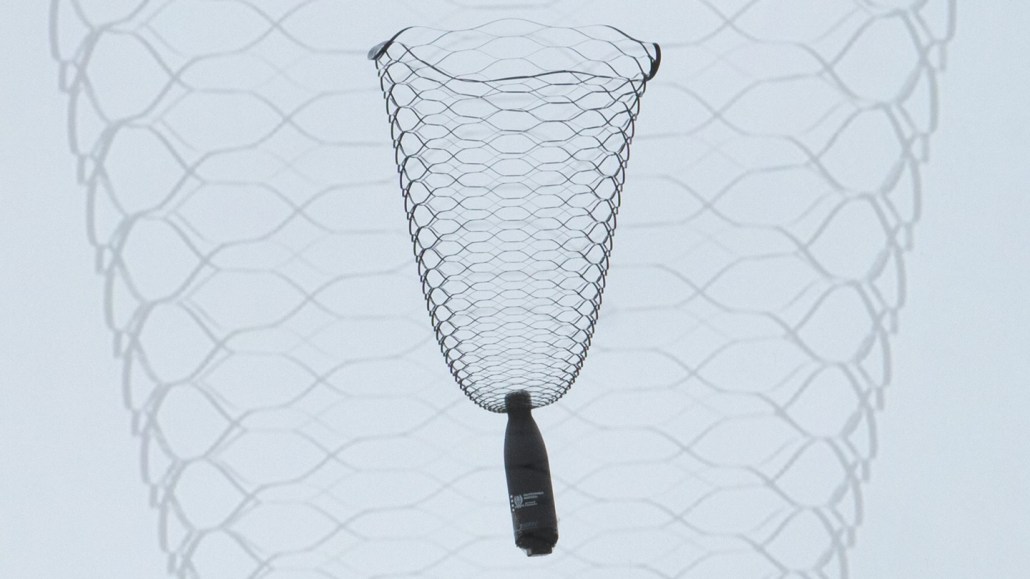
A water bottle is gently lowered by a parachute (center) made of a thin plastic disk. The disk has cuts that allow it to unfurl as the bottle falls (close-up of the parachute shown in background).
Frédérick Gosselin
Share this:
- Share via email (Opens in new window) Email
- Click to share on Facebook (Opens in new window) Facebook
- Click to share on X (Opens in new window) X
- Click to share on Pinterest (Opens in new window) Pinterest
- Click to share on Reddit (Opens in new window) Reddit
- Share to Google Classroom (Opens in new window) Google Classroom
- Click to print (Opens in new window) Print
New unfurling parachutes really hit the mark. Scientists were inspired by the Japanese art of kirigami, or paper cutting. They made parachutes that open automatically when dropped. And unlike typical cloth parachutes, where they land doesn’t depend on how they were dropped. This makes their falls more predictable.
“I can toss this thing any way I want,” says David Mélançon. He’s a mechanical engineer at Polytechnique Montreal in Quebec, Canada. “It will always realign and then fall straight down,” he says as he slings one of the team’s disks.
It’s made of a plastic called Mylar. Slits are arranged in a series of rings that extend to the disk’s edge. They allow the disk to expand into an elegant netlike vase as its attached cargo falls. Pulled open by the rush of air, the chute’s shape slows the payload’s fall by producing drag. That’s a force that resists an object’s motion.
The team compared its new parachute against traditional parachutes in the lab. The kirigami parachutes fell closer to an intended target, the researchers found. They shared their results in the Oct. 2 Nature. The parachutes would also be simple to make and deploy, Mélançon says. Traditional fabric parachutes require sewing and folding.
As a simple test, the researchers attached a 1-kilogram (2.2-pound) water bottle to a kirigami parachute 0.5 meter (1.6 feet) across. They dropped it from a drone flying at a height of 60 meters (200 feet). The bottle reached a speed of about 14 meters per second (46 feet per second). A bottle without a parachute would’ve topped out at about 34 meters per second (112 feet per second).
Because they’re full of holes, the new parachutes produce less drag than similarly sized fabric parachutes. That means they have to be bigger than a normal parachute. So they might not be practical for large things. Consider a person. To keep from crash-landing, a human might need a kirigami parachute a couple hundred meters (yards) across, Mélançon suggests. That would be longer than two football fields!
These new parachutes could help with smaller drops, though. For instance, they could be used to deliver packages by drones. Or they could be used for dropping food or other supplies from airplanes in hard-to-reach areas, he says.
The team is also considering using materials like cardboard that can break down easily in the environment. And there may be other ways to tweak the parachutes’ design. For example, the disks could be cut so that they fall with the whirling motion of winged maple seeds. That could come in handy on space missions to other planets. It would let an on-board camera take photos from all angles as it descends through an alien atmosphere.