astronaut: Someone trained to travel into space for research and exploration.
astronomer: A scientist who works in the field of research that deals with celestial objects, space and the physical universe.
Atlantic: One of the world’s five oceans, it is second in size only to the Pacific. It separates Europe and Africa to the east from North and South America to the west.
cosmic: An adjective that refers to the cosmos — the universe and everything within it.
cosmic rays: Very high-energy particles, mostly protons, that bombard Earth from all directions. These particles originate outside our solar system. They are equivalent to the nucleus of an atom. They travel through space at high rates of speed (often close to the speed of light).
electron: A negatively charged particle, usually found orbiting the outer regions of an atom; also, the carrier of electricity within solids.
electronics: Devices that are powered by electricity but whose properties are controlled by the semiconductors or other circuitry that channel or gate the movement of electric charges.
field: (in physics) A region in space where certain physical effects operate, such as magnetism (created by a magnetic field), gravity (by a gravitational field), mass (by a Higgs field) or electricity (by an electrical field).
magnetic field: An area of influence created by certain materials, called magnets, or by the movement of electric charges.
particle: A minute amount of something.
planet: A large celestial object that orbits a star but unlike a star does not generate any visible light.
poles: (in Earth science and astronomy) The cold regions of the planet that exist farthest from the equator; the upper and lower ends of the virtual axis around which a celestial object rotates.
proton: A subatomic particle that is one of the basic building blocks of the atoms that make up matter. Protons belong to the family of particles known as hadrons.
solar system: The eight major planets and their moons in orbit around our sun, together with smaller bodies in the form of dwarf planets, asteroids, meteoroids and comets.
solar wind: A flow of charged particles (including atomic nuclei) that have been ejected from the surface of the star, such as our sun. It can permeate the solar system. When emitted by a star other than the sun, this radiation is known as a stellar wind.
sun: The star at the center of Earth’s solar system. It is about 27,000 light-years from the center of the Milky Way galaxy. Also a term for any sunlike star.
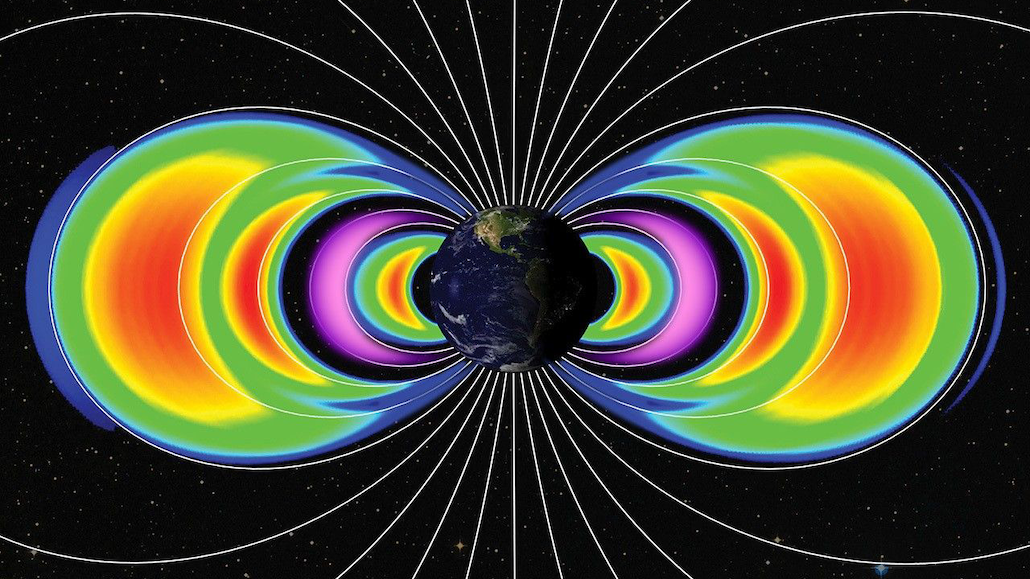
Van Allen belts: Two belts, an inner and outer one, surrounding Earth. They consist of cosmic rays — charged particles (electrons and protons). The belts extend from about 13,000 to 60,000 kilometers (8,100 to 37,300 miles) above the planet’s surface. The high energy particles, a type of radiation, vary over time and altitude and pose a health risk to exposed space travelers.