Scientists shrink 3-D printing so it can work inside cells
The new tech created barcodes, micro-lasers and a tiny elephant — all in living cells

With the use of a laser, scientists 3-D printed tiny structures within human cells (like those shown here).
HeitiPaves/iStock/Getty Images Plus
For the first time, scientists have 3-D printed objects within living cells. They included a mini elephant and tiny barcodes that could help track individual cells. Remarkably, many of the cells lived to tell the tale.
“It’s amazing to see that some of the cells actually do survive,” says Kerstin Göpfrich. “Honestly, I wouldn’t have thought this. If you told me, I would have been like, ‘Nah, never.’” Göpfrich is a biophysicist at Heidelberg University in Germany who did not take part in the new work.
Physicist Matjaž Humar was part of a team that made these structures. He works at the Jožef Stefan Institute in Ljubljana, Slovenia. His team started by injecting cells with a special goo called a photoresist. When hit with light from a laser, the photoresist hardens. Human’s team focused the laser to a tiny area. By moving the where it was focused, they created small but incredibly detailed structures. Afterward, they let the leftover photoresist dissolve.
The technique is novel and exciting, says Malte Gather. He’s an optical physicist at the University of Cologne in Germany who was not involved in the project.
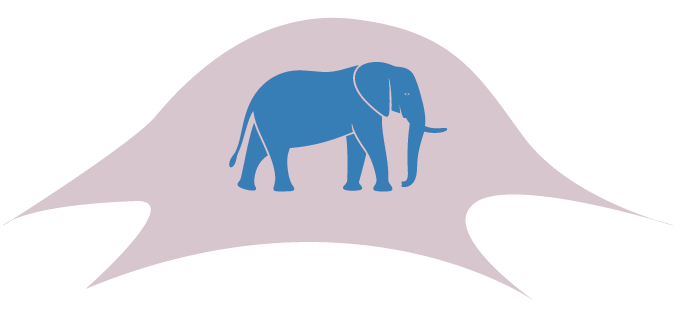
Humar’s team used the new tech to make barcodes. These look like a stack of grids, each bearing a different pattern. These could be used to tag cells. In another demo, the team sculpted an elephant. It’s “a very nice symbol,” Gather says. What’s usually large is contained within something super-tiny. In this case the elephant is only 10 micrometers wide — about a tenth of the thickness of a strand of hair.
A stab at printing in cells
Scientists have previously implanted trinkets in cells by getting them to “swallow” foreign objects. But only certain varieties of cells are keen gobblers. 3-D printing has the advantage of working in other types of cells.
But stabbing a cell and pumping liquid into it could kill it. Worse, many photoresists are toxic. Indeed, even with the least toxic photoresist, many cells died within 24 hours.
“It seems to be related simply to the fact that cells don’t like having liquids injected into them,” says Gather at Cologne. For now, that injection is a requirement for 3-D printing.
To boost the cells’ odds of survival, Humar’s team combed through existing photoresists. They chose one that seemed fairly cell-friendly. And upon 3-D printing, some cells not only survived but went about their business as if nothing had happened. Some cells even divided. These cells split in two, passing on a 3-D-printed inheritance to one of the daughter cells.
Humar’s team shared its results in a study posted June 16 at arXiv.org. It has not yet been peer-reviewed by other scientists. Humar has declined to comment on the new work while his team’s paper is waiting formal publication in a peer-reviewed journal.
Teeny, tiny lasers
Better photoresists or injection techniques might improve the success rate. Scientists might even skip the injection by using a photoresist that can cross cell membranes, Göpfrich says.
In addition to the elephant and barcodes, the researchers 3-D printed a micro-laser. It consists of a tiny sphere. When illuminated, it traps and amplifies light inside it. Micro-lasers could also be used to track cells. Subtle variations in the sphere size change the light the laser emits. So each cell could have a distinct light signature.
Micro-lasers could also be used to sense conditions within a cell, Gather says. For instance, some molecules might latch onto the sphere’s surface and alter the laser’s light signal.
Scientists aren’t sure yet how the 3-D printing technique will be useful. In its paper, Humar’s team proposes creating barriers within cells. Such tiny structures could isolate parts of a cell so that scientists could study their function.
This could create new ways to study cells without modifying their DNA. It would open up new possibilities, Göpfrich says.
Do you have a science question? We can help!
Submit your question here, and we might answer it an upcoming issue of Science News Explores