Scientists Say
A weekly word defined, in a sentence and in context. Click here to find the alphabetized list.
- Earth
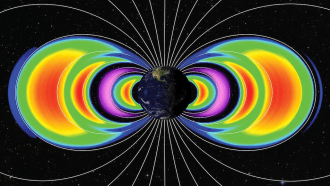
Scientists Say: Van Allen belts
Astronomers have detected these radiation belts around Earth and beyond. Jupiter’s belt is thousands of times as intense as Earth’s.
- Physics
Scientists Say: Blue whirl
Four types of smaller flames create the perfect firestorm of elegantly efficient combustion.
- Animals
Scientists Say: Kleptotrichy
Based on the Greek words for theft and hair, kleptotrichy is a more common bird behavior than people thought.
- Earth
Scientists Say: Supermoon
This supersized lunar event occurs when a full moon or new moon coincides with the moon’s perigee — the point where it is the closest to Earth.
- Microbes
Scientists Say: Microcin
Small and deadly (to bacteria), these protein-like molecules fight the growth of potentially dangerous germs in our gut.
- Life
Scientists Say: Benthic
This ecological region teems with life — from coral to insect larvae to crabs.
- Humans
Scientists Say: Artifact
Take note: This term might describe ancient pottery shards in the field of archeology. But in statistics, it’s a misleading pattern in data.
- Physics
Scientists Say: Infrasound
“Listening” for changes in these deep rumblings can allow scientists to predict earthquakes and other geological events.
- Ecosystems
Scientists Say: Transplant
Transplant means to move something from one place to another. A transplant can involve something as small as a cell or as large as a whole population.
- Chemistry
Scientists Say: Element
The number of neutrons and electrons can vary in atoms of the same element. The number of protons alone sets each of these substances apart.
- Math
Scientists Say: Quantitative and Qualitative
These two research approaches collect different forms of data. Both help scientists unlock secrets and build knowledge.
- Life
Scientists Say: Biodiversity
The coral reefs at Komodo, one of the Lesser Sunda Islands in Indonesia, are among the most diverse ecosystems on Earth.