Some gifted dogs can learn to sort their toys
Recognizing toys by how they are used during play shows complex thinking
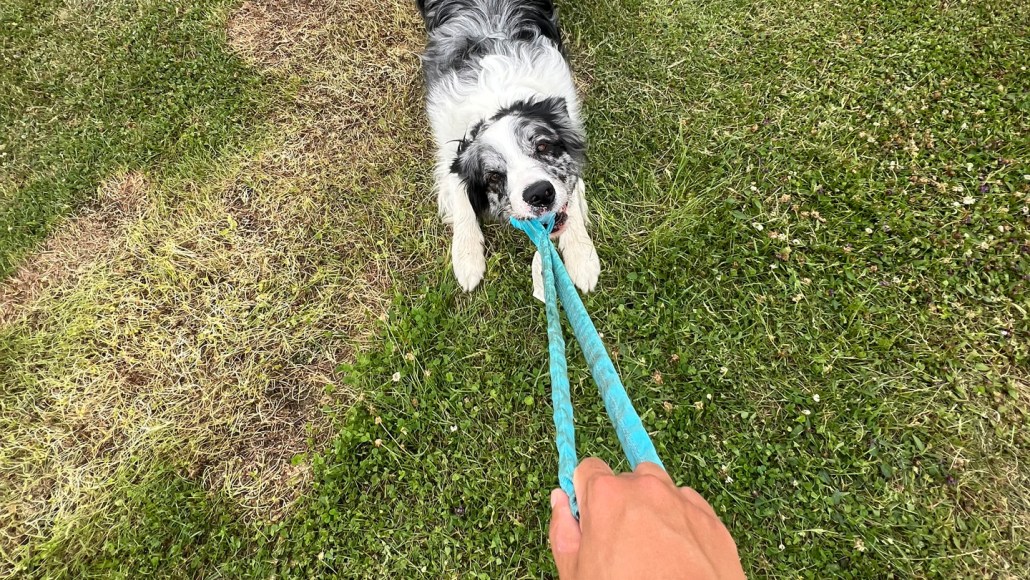
Harvey, a border collie, enjoys tug-of-war with a pull toy. Border collies are among dog breeds that are good at recognizing toys by name.
Claudia Fugazza
“Where’s your squeaky ball? Bring me your panda bear!” It’s not unusual for some dogs to learn the names of their favorite toys. But some dogs can categorize toys by how they’re used during play, researchers now report. These dogs can even decide what category a new toy should be in, based on how it’s used. And that’s without any verbal or physical clues.
This work came about after a dog in another study could sort her own toys into categories like ball, rope and ring. She could even “sort toys she’d never seen before into those categories,” says Claudia Fugazza of Eötvös Loránd University. That’s in Budapest, Hungary.
“We wanted to test whether dogs could also classify a toy based strictly on how it is used during play, rather than on shared physical traits,” Fugazza says. This animal behavior researcher led the new study in the Oct. 6 Current Biology.
Tug or fetch?
Her team focused on dogs known as gifted word learners. These were pets famed for their extensive vocabulary of toy names. Many were border collies who picked up on the toy names during casual at-home play.
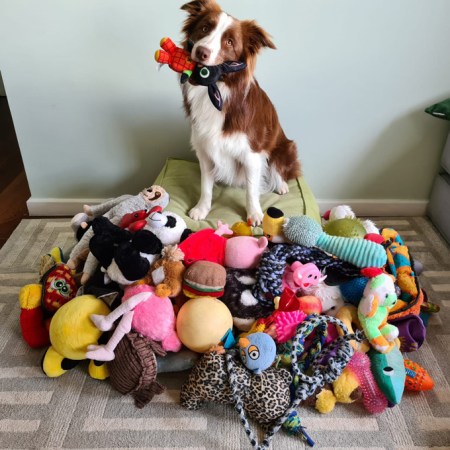
The researchers recruited 11 such gifted word learners and their owners to take part. Seven completed the project.
Each dog was studied at home. First, owners played games with their dogs: either “pull” or “throw.” In other words, they played tug-of-war or fetch. The toys they used ranged from braided ropes to plushies and squeakers.
During each game, the owner repeatedly said the category out loud. Toys were assigned to a category at random. In other words, a toy’s physical traits did not dictate how it would be used.
Game playing continued until the dogs related each toy to either “pull” or “throw.” Then, owners and dogs played the same pull or throw game with toys the dogs had not seen before. This time, the owners did not name the activities out loud.
Next, owners asked their dogs to “bring me a pull” or “bring me a throw” from a toy pile. This tested if the dogs applied the labels based on their play with that toy. Correct picks suggest the dogs could generalize the same labels from the old toys to the new ones.
These dogs picked a new toy right most of the time — in 31 out of 48 trials. This was despite never having heard the categories for those items said out loud. Most “mistakes” were in choosing an old pull or throw toy they had learned earlier.
Thought processing
Previous animal studies that categorized things by their use had been done in a lab. They also relied on formal training. “This is the first study exploring this cognitive skill in animals in their natural environment,” Fugazza says. Here, it was dogs “at home playing naturally with their owners.”
Earlier research also hadn’t considered physical or other cues the dogs might have gotten. The new study made sure the dogs got only social cues — that is, how their owners had them play with a toy.
Such learning in a natural setting suggests the dogs could figure out a toy’s use from context. That’s “both more sophisticated and more ecologically valid than we’ve appreciated,” says Vanessa Woods. She’s an evolutionary anthropologist at Duke University in Durham, N.C. She also directs a project known as the Duke Puppy Kindergarten.
The new findings demonstrate “that dogs are not only memorizing labels but can also flexibly use them in a way that reflects deeper categorization,” she says.
Do you have a science question? We can help!
Submit your question here, and we might answer it an upcoming issue of Science News Explores
Next, researchers may want to explore what other mental categories these dogs can learn. Figuring out what brain activities underlie these abilities would be something else to look into.
“It’s exciting to see dogs recognizing, remembering, inferring,” Fugazza says. “It takes a lot of cognitive processing to do what they’re doing.”
Fugazza calls these gifted word learners her “ambassadors to understanding dog cognition.” She says the new study doesn’t show that all dogs have this functional-labeling skill. “But,” she adds, “I wouldn’t exclude that.”