Ants are better team players than people [COMIC]

Faced with the same puzzle, groups of humans and ants showed some surprising differences

a team of longhorn crazy ants pulling prey back to a nest

Longhorn crazy ants often have to team up to drag big prey back to their nests. In a recent experiment, scientists pitted the ants’ teamwork against that of humans.

Brett Hondow/iStock/Getty Images Plus

Groups of ants seem to be smarter than the sum of their parts. But for groups of humans, that’s not always the case.

In lab experiments, scientists gave longhorn crazy ants (Paratrechina longicornis) and people the same puzzle. The goal was to get a weirdly shaped object through a tight maze along as short a path as possible.

Ofer Feinerman and his colleagues ran this two-species tournament at the Weizmann Institute of Science. That’s in Rehovot, Israel. The setup offered a rare chance to directly compare problem-solving in two vastly different creatures, Feinerman says. “Another motivation to do it [was] just for the fun and funniness of it.”

These ant-ics did yield some surprising results, which the researchers shared last December. The work appeared in Proceedings of the National Academy of Sciences.

illustrated text reads "Wild Things: A graphic tale" with animals drawn around the letters
Title Panel: Text: Ants’ Amazing Teamwork. Written by Maria Temming. Illustrated by JoAnna Wendel. Image: Two ants team up to carry a crumb nearly twice as big as themselves. One of the ants is yelling, “And, heave!”
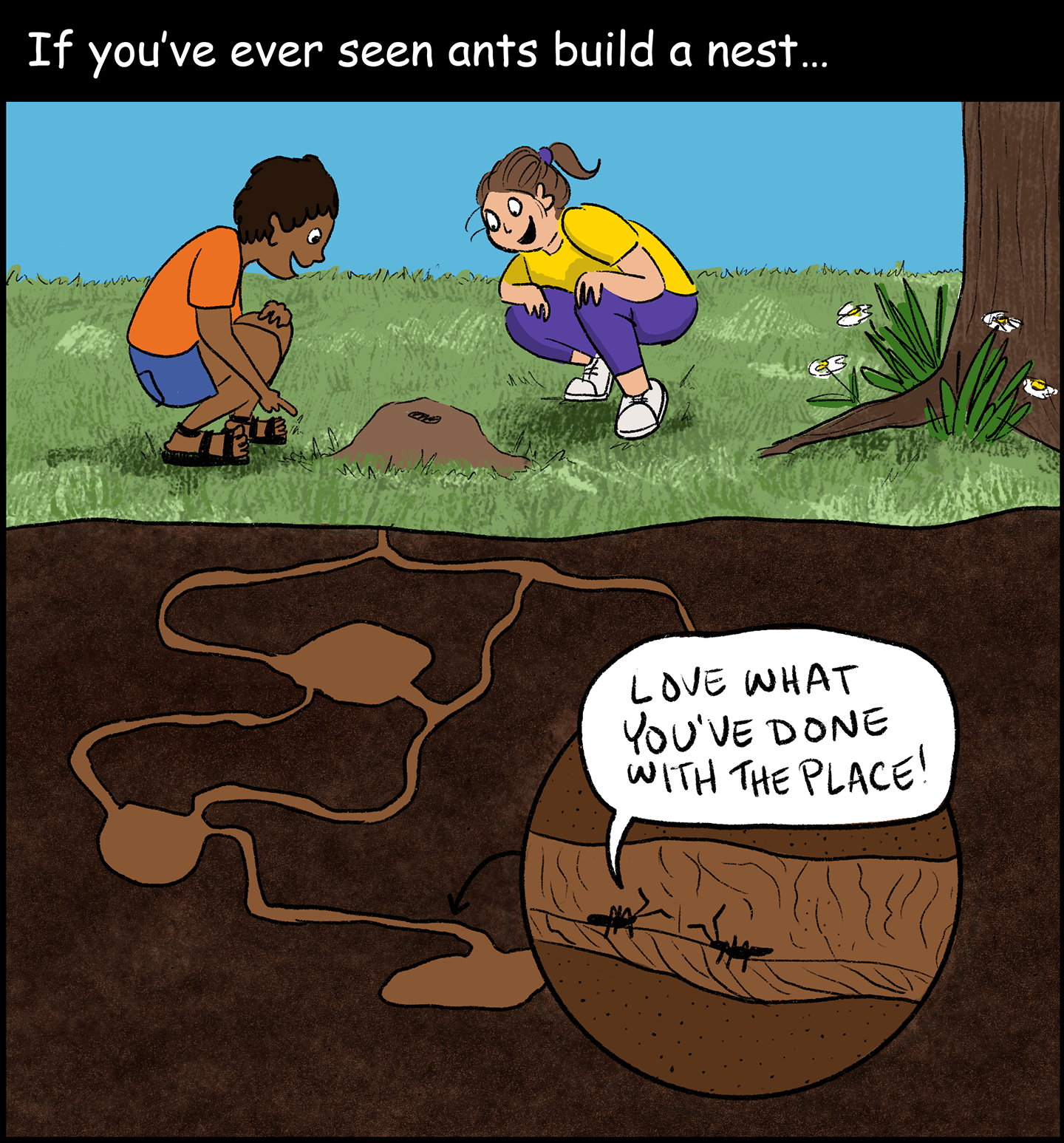
Panel 1: Text (above image): If you’ve ever seen ants build a nest… Image: Two kids look at an anthill built into a patch of grass beneath a tree. Underground below the anthill are tunnels carved into the soil. An inset shows two ants inside one of the tunnels. One ant is saying to the other, “Love what you’ve done with the place!”
Panel 2: Text (above image): …or form a neat line to carry crumbs home… Image: Two kids sit on the floor of a kitchen, eating a sandwich and a bag of chips as a line of ants marches from the counter, down one of the cabinets and across the floor. Text (below image): …then you know these insects are good team players. But how good? As good as people? Better?
Panel 3: Image: A male scientist in a lab coat and glasses stands in his office. Behind him, there is a shelf full of books and an ant farm. He is saying, “It’s a very difficult theoretical question, actually!” Text (below image): This is Ofer Feinerman. He studies social insects at the Weizmann Institute of Science in Rehovot, Israel. To test ant vs. human teamwork, he and his colleagues needed a challenge both species could tackle.
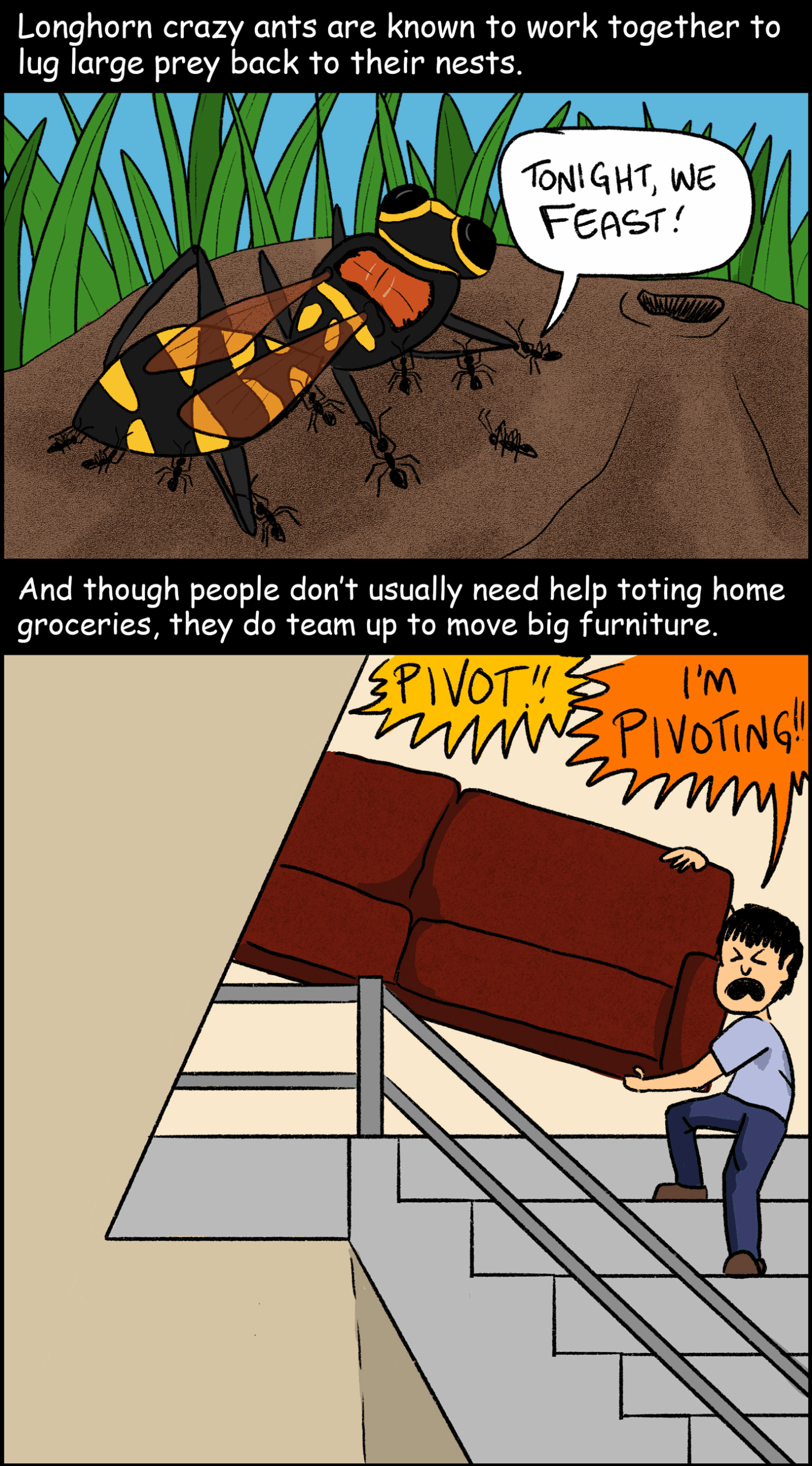
Panel 4: Text (above first image): Longhorn crazy ants are known to work together to lug large prey back to their nests. First image: A group of ants works together to carry a wasp much bigger than themselves back to the mouth of their nest in the grass. One of the ants is yelling, “Tonight, we feast!” Text (below first image, above second image): And though people don’t usually need help toting home groceries, they do team up to move big furniture. Second image: Two people carry a couch up a winding staircase. From out of sight, one person is yelling, “Pivot!” The other person yells back, “I’m pivoting!”
Panel 5: Text (above images): So the researchers set both species the same puzzle: get an awkwardly shaped object through a cramped maze. First image: A group of ants try to carry a T-shaped item through a maze, toward their nest at the end of the maze. Second image: A group of people try to carry a T-shaped item through a maze that is much larger than, but otherwise identical to, the ants’ maze. Text (below images):  The scientists bribed ants to take part by rubbing their cargo with cat food, making it smell like a tasty treat the ants would want to take home.
Panel 6: Text (above image): Ants working solo or in small groups struggled to solve the maze. Image: Ofer Feinerman says, “When a small group or single ant hits a wall, it’s such a big shock to them that they will just choose a random new direction.” Below him, an inset shows a small group of ants try to get their T-shaped object through the maze. The object has hit a wall. One ant says, “OK, no one panic.” Another ant says, “Everybody panic!!”
Panel 7: Text (above image): Groups with dozens of ants solved the maze much more efficiently. When these groups hit a wall, they had enough momentum to slide along it until they found an opening, or back away if they found a dead end. Image: Ofer Feinerman says, “It’s harder for the thing to change direction, because you need many ants at once to suddenly change direction.” Below him, an inset shows a large group of ants trying to get their T-shaped object through the maze. One ant says, “This doesn’t seem right…” Another ant says, “Just go with it.”
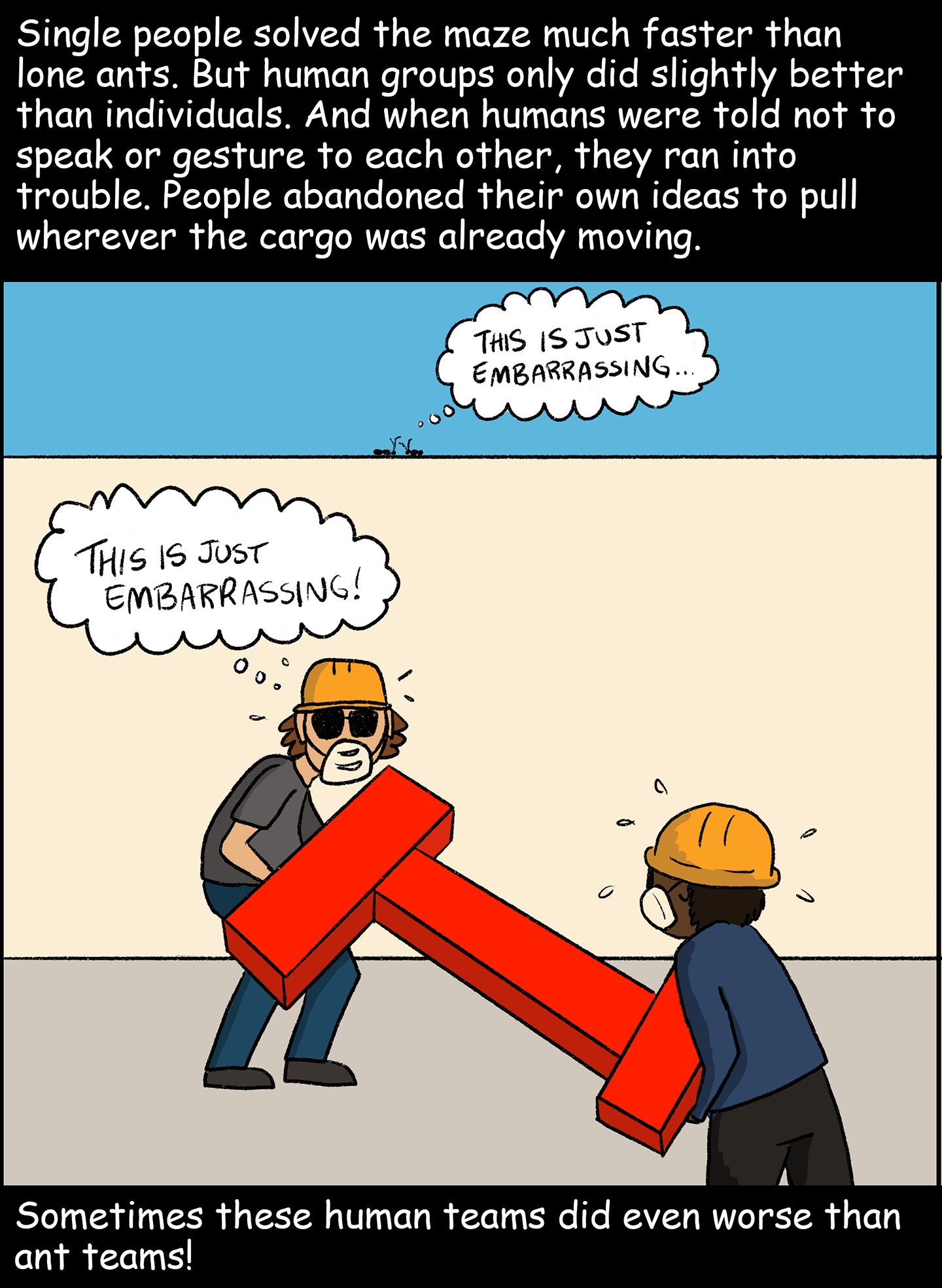
Panel 8: Text (above image): Single people solved the maze much faster than lone ants. But human groups only did slightly better than individuals. And when humans were told not to speak or gesture to each other, they ran into trouble. People abandoned their own ideas to pull wherever the cargo was already moving. Image: Two people wearing sunglasses and masks try to maneuver their T-shaped object through a maze. A pair of ants watches. One of the ants is thinking, “This is just embarrassing…” One of the humans is also thinking, “This is just embarrassing!” Text (below image): Sometimes these human teams did even worse than ant teams!
Panel 9: Text (above image): Luckily, the human maze solvers weren’t sore losers. A lot of people were impressed that ant teams did so well in the two-species tournament. Image: A kid crouches down in the grass to shake an ant’s foot with his finger. The kid says, “Rematch?” The ant says, “Any time, any maze.”
Panel 10: Text (above image): These insects may even be able to teach us a thing or two about teamwork. Image: Ofer Feinerman watches three ants crawl across his finger. He says, “Different ants lead at different times. They give this idea a chance, and then switch to another idea. There’s no ant trying to cling on to power.” Text (below image): That strategy might be adv-ant-ageous for human teams, too.

Maria Temming is the Assistant Managing Editor at Science News Explores. She has bachelor's degrees in physics and English, and a master's in science writing.

JoAnna Wendel is a freelance science writer and cartoonist in Portland, Ore. She loves to make comics about all types of science, but she especially loves drawing planets, invertebrates and sea creatures. When she's not drawing, JoAnna is probably reading, hiking or hanging out with her cat, Pancake.