astronomy: The area of science that deals with celestial objects, space and the physical universe. People who work in this field are called astronomers.
astrophysicist: A scientist who works in an area of astronomy that deals with understanding the physical nature of stars and other objects in space.
astrophysics: An area of astronomy that deals with understanding the physical nature of stars and other objects in space. People who work in this field are known as astrophysicists.
atmosphere: The envelope of gases surrounding Earth, another planet or a moon.
Coriolis effect: An apparent force that’s due to a planet’s rotation on its axis. This movement shifts moving objects (such as airborne footballs or winds) to the right in the Northern Hemisphere and to the left in the Southern Hemisphere.
current: A fluid — such as of water or air — that moves in a recognizable direction.
equator: An imaginary line around Earth that divides Earth into the Northern and Southern Hemispheres.
factor: Something that plays a role in a particular condition or event; a contributor.
filter: (in physics) A screen, plate or layer of a substance that absorbs light or other radiation or selectively prevents the transmission of some of its components.
force: Some outside influence that can change the motion of an object, hold objects close to one another, or produce motion or stress in a stationary object.
gas giant: A giant planet that is made mostly of helium and hydrogen, which on Earth are gases. Jupiter and Saturn are gas giants.
infrared: A type of electromagnetic radiation invisible to the human eye. The name incorporates a Latin term and means “below red.” Infrared light has wavelengths longer than those visible to humans. Other invisible wavelengths include X-rays, radio waves and microwaves. Infrared light tends to record the heat signature of an object or environment.
jet stream: A fast-flowing, high-altitude air current. On Earth, the major jet streams flow from west to east in the mid-latitude regions of the Northern and Southern Hemispheres.
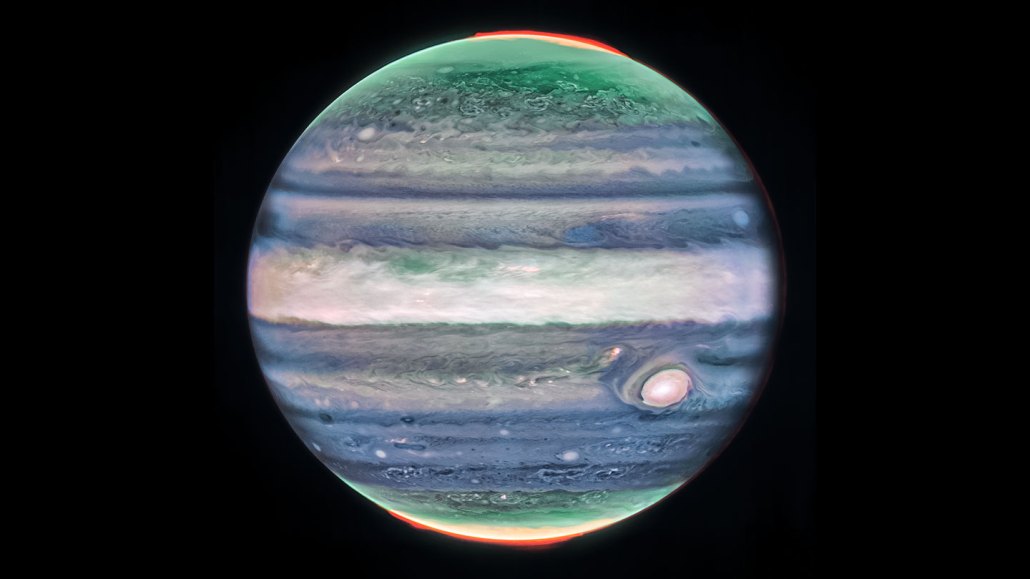
Jupiter: (in astronomy) The solar system’s largest planet, it has the shortest day length (9 hours, 55 minutes). A gas giant, its low density indicates that this planet is composed mostly of the light elements hydrogen and helium. This planet also releases more heat than it receives from the sun as gravity compresses its mass (and slowly shrinks the planet).
physics: The scientific study of the nature and properties of matter and energy. Classical physics is an explanation of the nature and properties of matter and energy. A scientist who works in such areas is known as a physicist.
planet: A large celestial object that orbits a star but unlike a star does not generate any visible light.
Saturn: The sixth planet out from the sun in our solar system. One of the two gas giants, this planet takes 10.6 hours to rotate (completing a day) and 29.5 Earth years to complete one orbit of the sun. It has at least 82 moons. But what most distinguishes this planet is the broad and flat plane of bright rings that orbit it.
steer: To guide the movement of something (a vehicle, a person or an idea) in some particular direction.
stratosphere: The second layer of the Earth’s atmosphere, just above the troposphere, or ground layer. The stratosphere stretches from roughly 14 to 64 kilometers (9 to about 31 miles) above sea level. Other planets with atmospheres may have a similar layer.
telescope: Usually a light-collecting instrument that makes distant objects appear nearer through the use of lenses or a combination of curved mirrors and lenses. Some, however, collect radio emissions (energy from a different portion of the electromagnetic spectrum) through a network of antennas.
troposphere: The lowest level of Earth's atmosphere. It runs from the planet's surface to a height of 8 to 14 kilometers (5 to 9 miles), depending on the latitude. It's the region where the air is thickest and where most weather occurs. Air currents moving through this region often flow not only horizontally, but often vertically (up and down). Other planets with atmospheres may have a similar layer.
Voyager: A pair of NASA missions conducting close-up explorations of Jupiter, Saturn, Saturn's rings and the larger moons of the both large planetary gas giants. The Voyager 2 craft launched Aug. 20, 1977 — 16 days earlier than Voyager 1. Both craft are near the edge of the solar system and still flying on into space.