Waves and Their Applications in Technologies for Information Transfer
- Genetics
How to view tiny parts of DNA? Make them ‘blink’
A new technique can image nanoscale structures in cells without hurting them. No dyes needed. All you have to do is stimulate them with the right color of light.
- Physics
Strange X-rays point to possible ‘dark’ matter
Scientists have been looking for “dark” matter. It’s supposed to make up most of the universe — but it’s also invisible. X-rays may now point to where some of this weird stuff is.
- Computing
LEDs offer new way to kill germs in water
Growing ultraviolet-light-emitting diodes on thin, flexible sheets of metal holds promise for water disinfection and other applications.
- Physics
Weird physics warps nearby star’s light
Scientists have observed a bizarre effect of quantum physics in light coming from a nearby neutron star.
- Computing
Computer hackers take to the cloud
People use cloud computing for storing files online. A new study shows the dark side of the cloud: These services can harbor malware.
- Computing
Star Trek technology becomes more science than fiction
On Star Trek, the characters used devices that seemed wild, futuristic and impossible. But those sci-fi gadgets are inspiring real-world, useful inventions.
- Brain
What makes a pretty face?
Beautiful faces are symmetrical and average. Do we prefer them because this makes them easier for our brains to process?
- Health & Medicine
Simpler way to screen for hidden hearing loss?
Many teens today walk around with undiagnosed hearing damage. But some Boston-based researchers have come up with a low-tech approach to screening these individuals so they can get help.
- Health & Medicine
‘Ringing’ in the ears may signal serious ear damage
A persistent ringing in the ears, also known as tinnitus, has become common in teens — and may point to eventual, permanent hearing loss.
- Physics
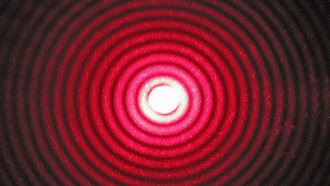
Scientists Say: Diffraction
When liquid hits something it spatters, when light hits something, it scatters. The process is called diffraction.
- Animals
Spidey sense: They can hear you!
Surprise! At least some spiders can hear us. Even without eardrums, jumping spiders can still detect airborne sounds from across the room.
- Animals
Creative ways to help coral reefs recover
Coral reefs are under siege from threats ranging from climate change to explosives. But scientists are developing ways to rebuild reefs before they disappear.